Evidence label: Research review — capabilities and prices below are from vendor announcements and third-party 2026 reporting, verified October 6, 2026. We did not test any agent ourselves; nothing here is a hands-on claim.
Plain-English Verdict: A chatbot answers your questions; an AI agent does your errands — it can click, fill forms, and finish multi-step tasks on its own. In 2026, the real ones live behind roughly $20-a-month subscriptions at ChatGPT, Claude, and Gemini, genuinely useful for web legwork and document chores, and genuinely not ready to run unsupervised.
What we actually did: We read vendor announcements and reputable 2026 write-ups from OpenAI, Anthropic, and Google, and translated them. No accounts were tested. The Plain Manual has no affiliate links and earns nothing if you subscribe to anything.
The 30-second version
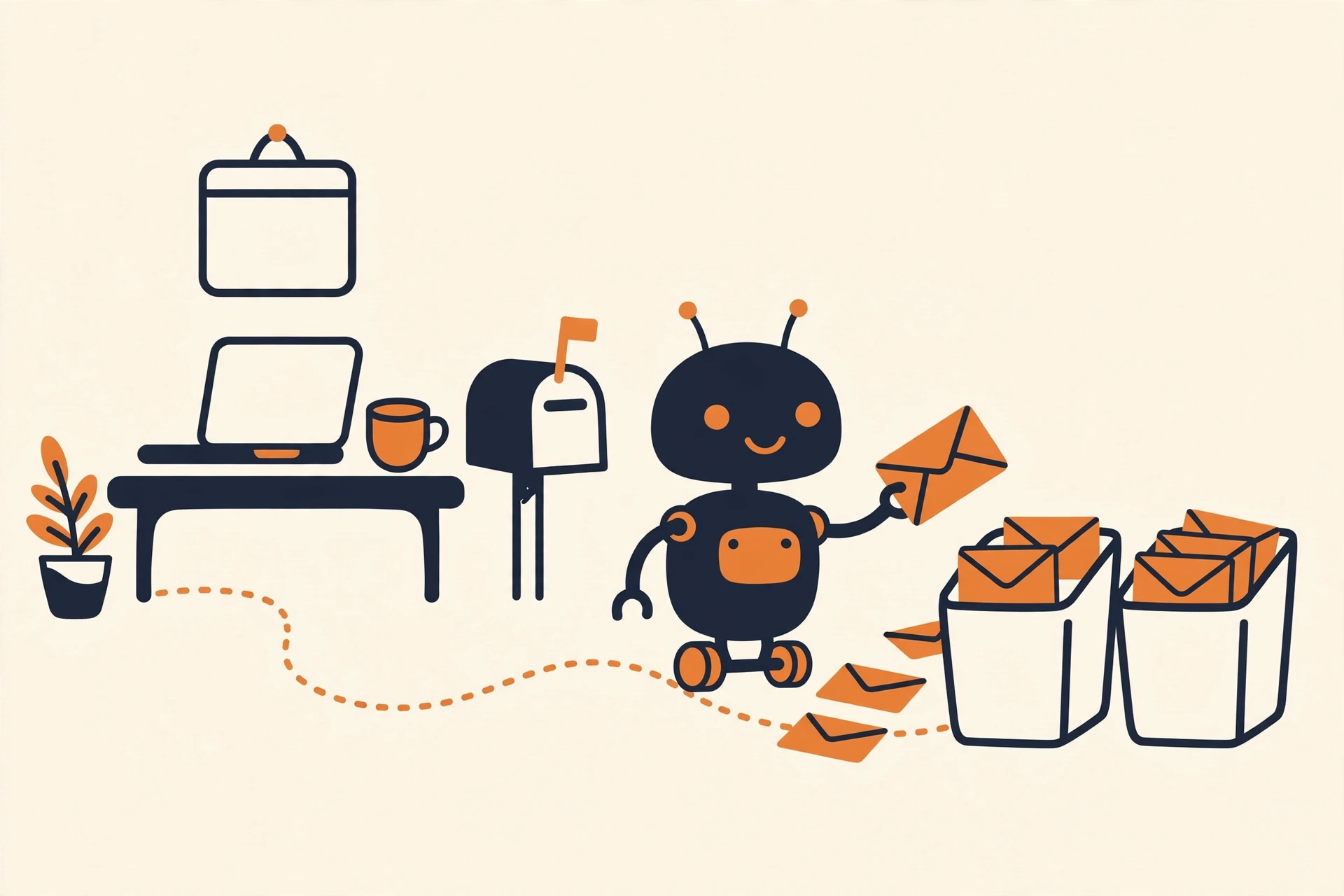
A chatbot is like a brilliant librarian who answers your questions but never leaves the desk. An AI agent is like hiring an assistant who leaves the desk, goes to the store, fills in the forms, and comes back with the job done.
The technical difference is one loop: the agent thinks about what to do next, takes an action using a tool (clicks, sends, updates), looks at the result, adjusts, and repeats. A chatbot’s output is a message; an agent’s output is a finished action.
Jargon Decoder: “Tool use” just means the AI can operate things, a browser, your email, a calendar, instead of only describing them. And watch the label: Gartner found roughly 95% of vendors calling something an “agent” didn’t meet a real bar, so judge the behavior, not the name.
Three real ones from 2026
1. ChatGPT’s agent mode
Flip a switch and ChatGPT stops just answering: it browses the web, clicks buttons, fills in forms, and works across multiple sites in sequence. OpenAI’s bigger ChatGPT Work package (launched July 2026) connects to apps like Gmail and Google Drive to turn one prompt into finished spreadsheets and slide decks, even running scheduled tasks on its own. The honest catch: it lives in OpenAI’s cloud sandbox (no local files), agent-mode messages are capped at about 40 a month on the $20 Plus plan, and CAPTCHAs stop it cold (via getaiperks’ 2026 comparison).
2. Claude’s computer use
Anthropic’s version operates a computer like you would, clicking, typing, moving between programs, inside an isolated virtual machine, asking permission before each new app. Great for document-heavy work: organizing files, pulling info across apps. The honest catch: it’s still a research preview, good enough for spreadsheets, not reliable enough to trust unsupervised; you confirm its plan before it executes (via mlq.ai’s 2026 coverage).
3. Gemini’s agent in Chrome
Google’s agent handles multi-step chores mixing web browsing with Google’s tools, inbox triage, rental-car pricing, and its auto browse in Chrome feature drives web pages itself, showing a step-by-step log with a “take over” button. Strongest inside Google’s own surfaces. The honest catch: daily limits on agentic actions, and purchases or social posts need your manual confirmation.
The honest limitations
Three things before you trust one with anything important. First, mistakes compound: a chatbot’s hallucination is one wrong sentence you can catch; an agent’s wrong step feeds every step after it, misread something at step two and it can confidently carry the error into a sent email by step four. Benchmarks show roughly 1 in 4–6 complex tasks goes wrong somewhere. Second, walls everywhere: CAPTCHAs block agents outright, and login-required sites usually need you to log in first. Third, the price: every major agent capability in 2026 sits behind a paid plan, roughly $20 a month is the entry ticket. Free tiers give you a chatbot; autonomy costs money.
Not sure which AI fits you? Our free quiz Which AI Should I Use? gives you a plain-English recommendation in 10 questions.
Do you need one?
The test is simple: do you have a repetitive multi-step chore, inbox triage, price comparisons, research that ends in a document, that eats an hour a week? An agent might give you that hour back, supervised. If your work is one question, one answer, a chatbot is already the right tool and the agent label is just marketing. Also see: what AI can actually do for a small business and how ChatGPT, Claude, and Gemini compare on everyday questions.
FAQ
Is an AI agent the same as a chatbot?
No. A chatbot’s output is a message; an agent’s output is a finished action. Agents run a loop, think, act with a tool, observe, adjust, until a goal is met.
Do AI agents cost money in 2026?
The real ones, yes. Agent features at ChatGPT, Claude, and Gemini all sit behind paid plans starting around $20/month. Free tiers give you chat, not autonomy.
Can I trust an AI agent to work unsupervised?
Not in 2026. Roughly 1 in 4–6 complex tasks goes wrong somewhere, and an early mistake compounds. Supervise anything irreversible.
Method: Research review (no hands-on testing). Cross-checked against vendor announcements and third-party 2026 reporting (seedandsociety, getaiperks, siliconangle, eweek, mlq.ai, digitaltrends, metirai). Checked October 6, 2026.
Corrections: Spotted an error? Tell us — we fix mistakes publicly and date them.
Prices: US list prices; verify before buying.
Source: Emergent’s AI agent vs chatbot explainer (via emergent.sh)