
Editor’s Note: First published October 2026.
Evidence: Research review — this comparison is built from the three companies’ official pricing pages, help centers, and feature tables as of October 2026. We did not run the same questions through all three bots as a lab test, so this is a guide to how the free tiers actually differ, not a hands-on trial. No affiliate links here; we earn nothing if you pick one.
Plain-English Verdict: For everyday questions, all three free tiers are genuinely good — the differences are about fit, not quality. Use ChatGPT if you want image generation and the biggest ecosystem; Claude if you write long documents or want the clearest explanations; Gemini if you live in Gmail and Google Drive. Paying $20/month mostly buys you higher limits and faster models, not a smarter everyday assistant.
What we actually did
We read the official free-tier documentation for all three, OpenAI’s Free Tier FAQ, Anthropic’s pricing page, and Google’s Gemini Apps help pages, and compared what each free tier actually includes: which model you get, the usage limits, and the standout features. Pricing is quoted from the companies’ own pages as of October 2026, and you should check those pages before deciding, since AI pricing changes the way weather used to. This site has no affiliate links, so our only incentive is being right.
The honest version of the marketing
Every AI company currently claims its chatbot is “the most intelligent,” “the most helpful,” and “your new everyday companion.” Translated to English: they’re all large language models with slightly different personalities, and for everyday questions, recipes, homework help, trip ideas, “explain this like I’m five”, any of the three will do the job well. The real question isn’t which is smartest. It’s which free tier fits the way you already work.
Jargon Decoder: A “token“ is the unit AI companies use to measure usage — roughly three-quarters of a word. When Claude’s docs brag about “200k tokens of context,” they mean it can read about 150,000 words at once: a whole novel. When limits are “compute-based,” it means longer, harder questions burn through your allowance faster.
1. ChatGPT, the one with the biggest toy box
What the marketing says: “The most popular AI assistant in the world.” What it actually is: the chatbot with the most stuff included for free — image generation, web search, and custom GPTs (mini-apps other people built) all work without paying.
What we like
The free tier runs on GPT-5.6 Luna and, here’s the genuinely surprising part, OpenAI now allows unlimited everyday text chats on free, where there used to be a hard cap. You also get image generation, file uploads, and voice mode on the free tier, which neither competitor fully matches. If your “everyday questions” include “make me a birthday invitation image,” this is the only free tier that does it well.
What could be better
Ads have started appearing on the free tier in some countries, you’re the product until you pay. And when you hit a tool limit (image generation, file analysis), ChatGPT just pauses that feature until the limit resets, with a notice.
Pricing
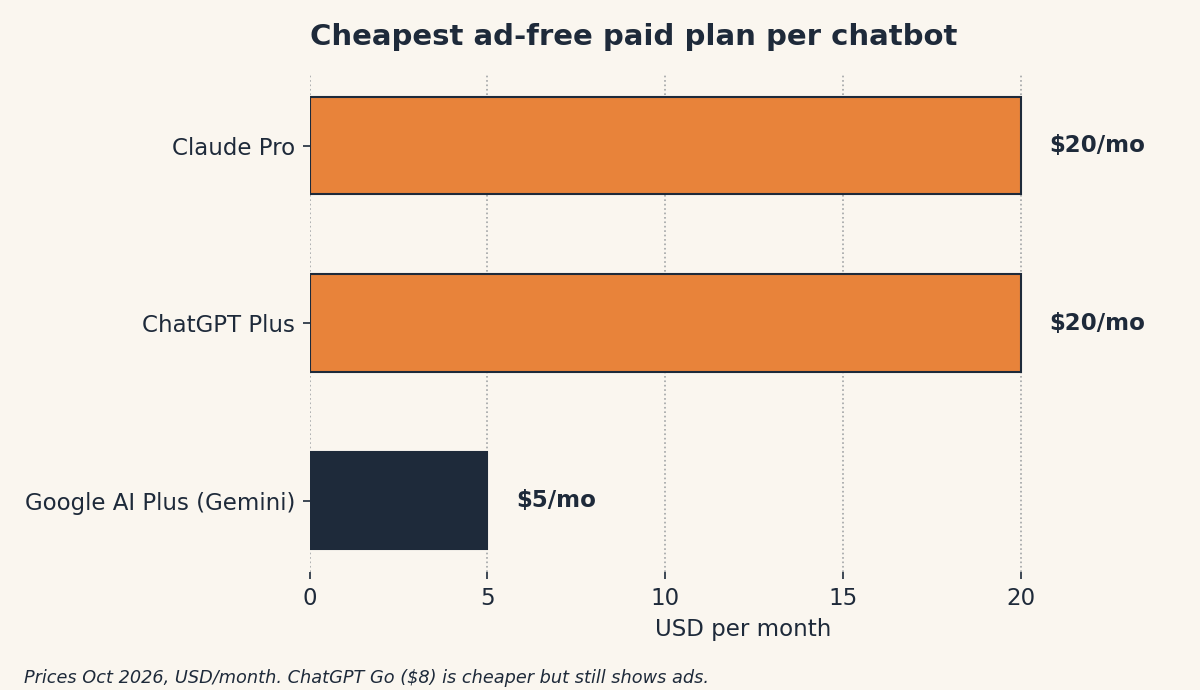
Free: $0. ChatGPT Go: $8/month (10x the free limits, longer memory, but still shows ads in the US). ChatGPT Plus: $20/month (advanced reasoning, priority access, no ads). Check OpenAI’s pricing page before buying; the tiers keep multiplying.
Our take
The best free tier for the curious dabbler, the person who wants to generate an image on Tuesday, plan a trip on Wednesday, and debug a spreadsheet on Thursday.
2. Claude, the clear writer
What the marketing says: “AI that’s helpful, honest, and harmless.” What it actually is: the chatbot with the best reputation for writing clearly and handling very long documents without losing the plot.
What we like
Claude’s free tier includes Artifacts, when you ask it to write something long, it opens a proper document panel instead of dumping a wall of text in chat. It also handles enormous documents (up to 200k–1M tokens of context across tiers, per Anthropic’s own table), which makes it the best free option for “summarize this 50-page PDF.” Web search, code execution, and connecting apps all work free too. Explanations tend to be structured and calm — the least likely of the three to bury the answer in fluff.
What could be better
Anthropic doesn’t publish exactly which model the free tier gets or a message count, usage “depends on conversation length” and resets on a rolling five-hour window. When you hit the limit, you wait. The free tier also skips image generation, which ChatGPT and Gemini both include.
Pricing
Free: $0. Claude Pro: $20/month (or $17/month billed annually), at least 5x the free usage per five-hour window, more models, plus Projects and scheduling features.
Our take
The best free tier for writers, students, and anyone whose everyday questions involve long documents. If your main use is “help me write this better,” start here. And if the documents in question are meeting transcripts, our Fathom vs. Otter.ai comparison covers the AI notetakers that summarize calls for you.
3. Gemini, the Google insider
What the marketing says: “Your AI assistant, everywhere you are.” What it actually is: the only chatbot that’s already inside your Gmail, Drive, and Docs — and the free tier is surprisingly generous because of it.
What we like
The free tier gets access to Gemini 3 Flash-Lite, Flash, and Pro, Google doesn’t gate its good models the way competitors do. Per Google’s own feature table, free users get Connected Apps (it can read your Gmail and Drive), image generation, Deep Research, Canvas, Audio Overviews (it turns documents into a podcast-style discussion), and even music generation. If you already live in Google’s world, this is the only assistant that can answer “find that email about the plumber.”
What could be better
Limits are compute-based and refresh every five hours up to a weekly cap, the mechanics are the most confusing of the three. The free context window is 32k tokens, far smaller than Claude’s. And Google’s habit of retiring features (Gems are being migrated to “Skills” for paid users in November 2026) means today’s free feature can be tomorrow’s upsell.
Pricing
Free: $0 with a Google account. Google AI Plus: around $5/month (double the limits, storage). Google AI Pro: $19.99/month. Ultra: from $99.99/month. Google’s plan names and prices shift often, verify on their site.
Our take
The best free tier for anyone embedded in Google’s ecosystem. The Gmail/Drive integration alone answers questions the other two literally cannot see.
Side-by-side: the free tiers
| ChatGPT (free) | Claude (free) | Gemini (free) | |
|---|---|---|---|
| Model you get | GPT-5.6 Luna | Not published (subset of models) | Gemini 3 Flash-Lite, Flash & Pro |
| Text chat limits | Unlimited everyday chats | Unpublished; 5-hour rolling window | Compute-based; 5-hour refresh + weekly cap |
| Image generation | Yes | No | Yes |
| Standout free feature | Custom GPTs, voice mode | Artifacts + huge document context | Gmail/Drive integration, Deep Research, Audio Overviews |
| Cheapest paid plan | $8/mo (Go) / $20/mo (Plus) | $20/mo ($17 annual) | ~$5/mo (AI Plus) |
| The catch | Ads in some countries | Vague limits; no image gen | Smaller context; features get retired |
This table is our original synthesis from the three companies’ official docs, October 2026 — the artifact for this post.
Still torn? Take our 60-second quiz Which AI Should I Use? — 10 questions, one plain-English recommendation.
The honest version: which should you actually use?
Here’s the part the marketing never says: you don’t have to pick one. They’re all free. The power move is using two, say, Gemini for anything involving your Google stuff and Claude for writing. The paid tiers mostly buy more (higher limits, priority access), not better answers for everyday questions. Start free, and only pay when you actually hit a limit that annoys you. That’s the whole decision tree.
FAQ
Which AI chatbot is best for everyday questions?
All three handle everyday questions well. Pick ChatGPT for image generation and extras, Claude for writing and long documents, Gemini if you use Gmail and Google Drive heavily.
Is the free version of ChatGPT good enough?
For everyday use, yes, unlimited text chats plus image generation and web search. You’d only need Plus ($20/month) for heavy daily use or advanced reasoning features.
Does Claude’s free tier really limit usage?
Yes, on a rolling five-hour window, though Anthropic doesn’t publish a message count, it depends on conversation length. For casual daily questions, most people don’t hit it.
Can Gemini really read my Gmail?
With your permission, yes — Connected Apps on the free tier let Gemini search your Gmail, Drive, and Docs. It’s opt-in, and it’s the feature the other two can’t match.
Should I pay $20/month for any of them?
Only if you hit free limits regularly or need the advanced features for work. For everyday questions, the free tiers are the best deal in software right now. Wondering whether to pay for any of them? Run the numbers: Is This AI Plan Worth It?
Sources
Built from official documentation, October 2026: OpenAI’s ChatGPT Free Tier FAQ and ChatGPT Plus page; Anthropic’s Claude plans & pricing; Google’s Gemini Apps limits & upgrades. We did not run a hands-on question-by-question test, so this is a research review, not a trial. Pricing changes often — check the official pages before buying. No affiliate links. Read our methodology.
Editor’s Note: First published October 2026.
Want one plain-English software take in your inbox every week? Subscribe to The Plain Manual newsletter — no spam, unsubscribe anytime.

5 thoughts on “ChatGPT vs Claude vs Gemini for Everyday Questions (2026)”