
Editor’s Note: New post, October 2026. Prices checked October 15, 2026. Budgeting apps reprice often, and first-year promo prices are not what you pay at renewal, so every figure below is the regular list price.
Research review: pricing and plan limits verified October 15, 2026 against each app’s published pricing as reported in current 2026 comparisons. No hands-on walkthrough was done for this piece.
In a sentence: Mint is gone, and the closest thing to it in 2026 is Monarch Money Core at $99.99 a year, unless you want a stricter budget (YNAB, $109 a year), a cheaper tracker (Quicken Simplifi, $71.88 a year), or a genuinely free option (Goodbudget).
Plain-English Verdict
If I had to pick one for most former Mint users, it is Monarch Money Core: it does the Mint job (every account in one place, spending by category, net worth over time) without asking you to learn a new budgeting religion. Pick YNAB instead if you want the app to change your habits, not just record them. And if paying $100 a year to watch your money feels wrong on principle, Goodbudget’s free tier is smaller and manual, but it is honestly free.
How we checked this
Checked: published 2026 pricing for YNAB, Monarch Money, Copilot Money, Quicken Simplifi, and Goodbudget, cross-checked across each vendor’s pricing figures as reported by The Penny Hoarder, BudgetLabs, OnlineToolGuides’ October 2026 verification table, and Ramsey Solutions’ comparison pages; Mint’s March 23, 2024 shutdown date and the Credit Karma handoff.
Date: October 15, 2026.
Method: Research review. See How We Review. We earn nothing if you buy any of these apps. There are no affiliate links in this post.
Here’s what a budgeting app does in one sentence: it pulls your bank, card, and loan accounts into one place, sorts your spending into categories, and shows you what is left before the month ends. Mint did that for free, supported by ads and product offers. Intuit shut Mint down on March 23, 2024 and pointed everyone at Credit Karma, which shows accounts and credit scores but dropped Mint’s actual budgeting features (via CNBC Select’s Mint alternatives roundup). So the honest starting point for this whole category in 2026 is: the free, automatic, does-everything option no longer exists. Everything good now costs money, does less, or asks you to type things in by hand. The picks below are the best versions of each trade.
Our picks, labeled by job
- Our pick for most Mint refugees: Monarch Money Core, $99.99 per year. The full dashboard, the least relearning.
- Our pick if you want to change your habits: YNAB, $109 per year. A budgeting method with an app attached.
- Budget pick: Quicken Simplifi, $71.88 per year at list. Most of the dashboard for the lowest regular price.
- Our pick for Apple households: Copilot Money, $95 per year. Beautiful tracking, Apple devices only.
- Our free pick: Goodbudget, $0. Digital envelopes you fill in yourself.
Skip this if…
Skip Monarch Money if you will not pay for a budgeting app on principle. There is no free tier, and the trial is only 7 days.
Skip YNAB if you want to glance at a dashboard once a week. YNAB only pays off if you work in it regularly, and its method takes a few weeks to click.
Skip Quicken Simplifi if confusing promo pricing annoys you. The first-year deal is not the renewal price, and you have to keep track of which one you are on.
Skip Copilot Money if anyone in your household uses Android. There is no Android app.
Skip Goodbudget if you will not enter purchases by hand. That is not a flaw in the app. It is the app.
1. Monarch Money: our pick for most Mint refugees
Monarch is the app that most directly rebuilt what Mint did: connect every account, see spending by category, watch net worth move, and share the whole picture with a partner at no extra charge.
What we like: the budgeting is flexible in a way Mint users will recognize. Set category targets, or use its simpler flex approach, and let the app keep score. Investment holdings sit next to everyday spending, recurring charges are easy to spot, and one subscription covers your household, which matters if two people need the same numbers.
What could be better: there is no free tier, the free trial is just 7 days, and you hand over a payment card to start it. Monarch also added a Plus tier in 2026 at $199 a year, with long-range forecasting and deeper investment analysis. Most households do not need it, and Core quietly went from “the plan” to “the cheaper plan,” which is a direction worth watching.
Pricing: Core is $14.99 per month or $99.99 per year. Plus is $199 per year. Our take: buy Core on the annual plan if the trial convinces you. Skip Plus unless you own rentals or run a business on the side.
2. YNAB: our pick if you want to change your habits
YNAB (short for You Need A Budget) is built on zero-based budgeting, which just means: give every dollar a job before you spend it, using only money that has actually arrived. It is less a tracker and more a practice.
What we like: it is the one app here designed to change behavior, with live workshops and guides built around the method. The 34-day free trial is the longest in this roundup and needs no credit card up front. One subscription can be shared with up to six people through YNAB Together, so a couple does not pay twice.
What could be better: at $109 a year it is the most expensive pick on this page, and the method has a real learning curve. Credit card handling confuses almost everyone for the first few weeks. Investment accounts only appear as simple tracking balances, with no holdings or performance view, so your net worth picture is thinner than Monarch’s.
Pricing: $14.99 per month or $109 per year, with a 34-day free trial. Our take: use the whole trial before judging it. If you are still opening it daily at day 34, it is probably earning its keep.
3. Quicken Simplifi: the budget pick
Simplifi is Quicken’s simpler, phone-first app: a spending plan, cash-flow projections, savings goals, and subscription monitoring, without the desktop-era complexity the Quicken name suggests.
The price: the regular price is $5.99 per month billed annually, which is $71.88 a year (via Tiller’s May 2026 pricing comparison). You will very likely see a first-year offer well below that, sometimes half price. That is a fine deal. Just budget for $71.88 at renewal, because that is the number that decides whether it stays cheap.
What we like: the lowest regular price of any full dashboard app here, a clear month-ahead cash-flow view, and good tools for spotting recurring charges before they renew.
What could be better: the promo merry-go-round makes its true price the hardest to pin down, and there is no permanent free tier. Its budgeting is a spending plan you check, not a method that coaches you, so habit-change seekers should look at YNAB instead.
Pricing: $71.88 per year at list, billed annually. Our take: if Monarch’s $99.99 makes you wince and you mainly want tracking with a light budget on top, this is the sensible middle.
4. Copilot Money: our pick for Apple households
Copilot is a polished tracking app for iPhone, iPad, and Mac, with a web version that is still catching up to the apps. Its party trick is automatic categorization that reviewers consistently rate the best in the category (via BudgetLabs’ August 2026 check against Copilot’s own site).
What we like: the cleanest, fastest-feeling app here, a generous one-month trial, and tracking that covers spending, investments, and recurring charges in one calm screen.
What could be better: there is no Android app at all, and it connects to US financial institutions only. Like Monarch and YNAB, there is no free tier once the trial ends. And it is fundamentally a tracker: it shows you what happened, beautifully, but it will not make you plan ahead the way YNAB does.
Pricing: $13 per month or $95 per year. Our take: if everyone in your house is on Apple devices and you want tracking that feels effortless, this is the one. Mixed-device households should cross it off on day one.
5. Goodbudget: the free pick
Goodbudget is the old cash-envelope system, digitized. You divide your money into envelopes (Groceries, Gas, Rent), and when an envelope is empty, you are done spending there. You fill the envelopes and log spending yourself.
What we like: the free tier is genuinely usable, not a demo: 10 regular envelopes plus 10 annual ones, one account, and sync across two devices, so a partner sees the same envelopes. No bank login is handed to anyone, which some people will count as the main feature.
What could be better: manual entry is the whole deal. Forget to log a few purchases and the envelopes stop matching reality. The free tier’s one account and one year of history also get tight quickly. Plus, at $10 per month or $80 per year, raises the limits to unlimited envelopes, five accounts, and five devices.
Pricing: Free, or Plus at $80 per year. Our take: start free for one month. Envelope people tend to know quickly whether they are envelope people.
The money, side by side
Who it’s for: anyone deciding with a calculator open. These are regular annual list prices, not first-year promos, because promos end and renewals do not ask permission.
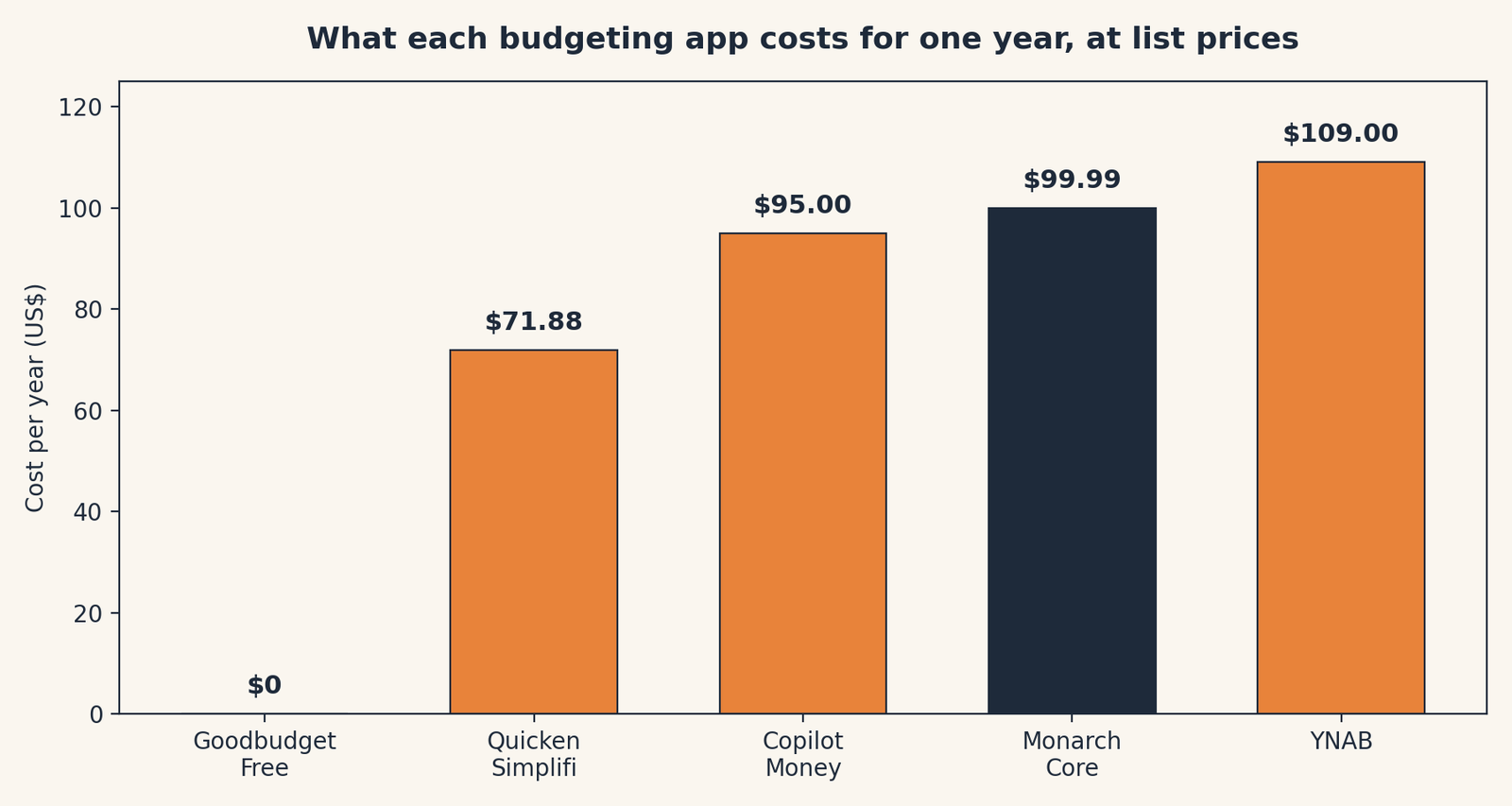
| App | Per year (list) | Free option | Trial | Best at |
|---|---|---|---|---|
| Monarch Money Core | $99.99 | None | 7 days | The full Mint-style dashboard |
| YNAB | $109 | None | 34 days, no card | Changing spending habits |
| Quicken Simplifi | $71.88 | None | Varies | Tracking on a smaller bill |
| Copilot Money | $95 | None | 1 month | Apple-only households |
| Goodbudget | $0 (Plus $80) | Yes, 20 envelopes | Free tier is the trial | Manual envelope budgeting |
Run those annual prices out five years and the gaps get real: Simplifi $359.40, Copilot $475, Monarch Core $499.95, YNAB $545, Goodbudget $0 (or $400 if you upgrade to Plus). None of that makes the expensive app wrong. It does mean the app you will actually open every week is worth more than the cheaper one you abandon by March, which is the same lesson Mint taught everyone for free.
The catch: almost every app here connects to your bank through a middleman service that imports your transactions. That is how the automation works, and it is standard across the category, but it is worth knowing before you link a main account to any app on a 7-day trial. Goodbudget’s manual entry is the exception, and for some readers that exception is the whole recommendation. Start with our guide to finding and cancelling subscriptions you are still paying for before adding a new one. A budgeting app should be the subscription that survives that audit, not one that fails it next year.
Run your own numbers: before you pay for a budgeting app, add up what your current subscriptions already cost you with our free Subscription Cost Calculator (on the Free Tools page). If a new $100-a-year app replaces two forgotten ones, it has paid for itself. If it just becomes line item number nine, you have your answer.
Method: Research review (no hands-on testing). Prices and plan limits cross-checked against each vendor’s published pricing as reported by The Penny Hoarder, BudgetLabs, Ramsey Solutions, and OnlineToolGuides’ October 2026 verification table. Checked October 15, 2026.
Corrections: Spotted an error? Tell us. We fix mistakes publicly and date them.
Prices: US list prices; verify before buying.
Source: OnlineToolGuides’ 2026 budgeting apps verification table (via OnlineToolGuides), checked October 15, 2026.
Like plain-English tool guides? Our newsletter rounds up the week’s posts every Saturday. Join here.