
*Editor's Note: New post, November 2026. Prices and plan limits checked November 22, 2026, at regular list prices, and renewal prices are the ones used in the text.*
*Research review: prices and plan limits verified November 22, 2026 against Harvest's pricing page, each alternative's official pricing page, and the BBC's August 2026 reporting. No hands-on walkthroughs, and no migration was performed by us.*
In a sentence: most people leaving Harvest need a time tracker whose bill they can predict, and in 2026 that is usually Toggl Track Starter at a flat $9 per user a month on annual billing, with Clockify free for teams of five or fewer.
Plain-English Verdict
Harvest still tracks time and sends invoices well. What changed is the bill: a per-seat price plus usage charges for the projects, clients, tasks, and invoices you create, with the per-unit rates printed nowhere on the pricing page. Toggl Track charges a flat per-user price and nothing for usage. Clockify is free for up to five users. FreshBooks folds time tracking into accounting. Kimai costs no licence fee at all if you host it yourself.
The worry: your renewal arrives after a year of work is already tracked and invoiced inside Harvest, and the new bill is several times the old one. The BBC reported one consultancy's monthly bill rising from $130 to $2,110 in August 2026, and Harvest's own billing example shows a $44 seats-only bill becoming $404 once usage charges are added. Switching under that deadline is the expensive mistake this post exists to prevent.
How we checked this
Checked: Harvest's pricing page (Free $0 for 1 seat and 2 projects; Teams from $9 per seat a month billed annually; additional invoices, projects, clients, and tasks billed based on use, with no per-unit rates printed); the BBC's August 20, 2026 report on the renewals; Toggl's, Clockify's, and FreshBooks' pricing pages; Kimai's site (open source, self-hosting free).
Date: November 22, 2026.
Method: Research review. See How We Review. We earn nothing if you buy any plan, and there are no affiliate links in this post.
Here is what Harvest does in one sentence. It is a time tracker with invoicing built in: hours logged against projects and clients turn into invoices without retyping.
Jargon Decoder: "Usage billing" just means: you pay for how much you use, on top of the seat price, the way a taxi meter runs after the flag drop.
Why people are leaving
What changed: Bending Spoons acquired Harvest in July 2025. During 2026, Harvest moved from a flat per-seat price to a seat price plus usage charges. The pricing page now reads "starting from" $9 per seat a month on Teams and $14 on Enterprise, billed annually. The per-unit usage rates appear nowhere on the page. They live inside your account's billing settings, so the page can tell you the least a year of Harvest costs and nothing about the most.
Usage can be paid two ways. Flex charges vary with the previous period's activity above an included allowance. Unlimited replaces them with one fixed usage fee, and Harvest does not publish that fee either. Usage charges start at a new account's second paid renewal, so the first bill usually covers seats alone, which is why the surprise lands at renewal rather than at signup.
The fine print: the reported renewals are the sharp end of this. The BBC described rises of as much as about 1,500 percent, and in November 2026 a self-employed contractor reported his bill rising from $13.32 to $133.98 a month. Harvest told the BBC that the steepest rises hit older legacy plans, and that renewal emails go out 30 and 10 days before the renewal date. Those figures are reported cases, not a price list. Your own number sits in Settings, then Billing, inside your account, and checking it today is the first step either way. Scheduling is a second bill, too: Harvest Forecast costs $5 per person a month billed annually, billed separately. And leaving is not free either: years of time entries and invoice history are the sticky part, so export first and cancel last.
The 60-second decision tree
- Flat, predictable price: Toggl Track Starter, $9 per user a month billed annually.
- Five people or fewer, budget zero: Clockify Free, $0.
- Time tracking and accounting in one bill: FreshBooks Plus, $43 a month.
- No subscription on principle: Kimai, self-hosted, $0 licence fee.
- Your renewal quote is close to the seat price: staying is a fair choice, priced below.
Skip this if…
Toggl Track Starter — you invoice clients from the tracker itself
Clockify Free — your team has more than five people
Clockify Standard — you need Harvest-style profitability reporting
FreshBooks Plus — you bill more than 50 clients
Kimai (self-hosted) — nobody on your team will run a server
Harvest Teams — you cannot state your yearly cost today
Quick poll: What pushed you here: a renewal quote, the usage charges, or a bill you could not predict?
Flat per-seat, time first: the predictable pick
Toggl Track: our pick for most people leaving
What it does in one sentence: Toggl Track is a time tracker priced per user, with no usage meter behind it.
Toggl Track Starter costs $9 per user a month billed annually, or $12 monthly. For five people that is $540 a year, and the sentence ends there: no charge per project, client, task, or dollar invoiced. Premium, at $16 per user a month billed annually, adds profitability reports, timesheet approvals, and single sign-on. The free plan covers up to 3 users, per Toggl's FAQ as read in November 2026 checks. Since September 2026 the new Toggl is the company's flagship, and its pages say Track remains available and supported for existing users.
What could be better: The catch: Toggl Track is a tracker, not an invoicing system. The invoice itself gets sent from your accounting tool, so a Harvest user whose billing lived in one app will run two tools after this move. Our Toggl Track vs RescueTime comparison prices Toggl directly.
Truly free for a small team: the $0 pick
Clockify: free for five, cheap after that
What it does in one sentence: Clockify is a time tracker whose free plan covers a whole small team rather than one person.
Clockify's pricing page, checked today, lists Free at $0 for up to 5 users, with unlimited tracking, timers, timesheets, and reports. Harvest's free plan, by contrast, is 1 seat and 2 projects. When a team outgrows five people, or needs invoicing inside the tracker, Clockify Standard costs $5.49 per seat a month billed annually: $329.40 a year for five people. Basic, at $3.99, adds exports and billable rates without invoicing.
What could be better: The catch: the free plan changed recently. It used to allow unlimited users; since April 2026 it stops at five, and invoicing waits for a paid tier. Price Clockify on today's page, not on the reputation it earned under the old rules. Our companion short today covers that cap on its own.
Time and accounting in one bill: the paperwork pick
FreshBooks: when the invoice is the point
What it does in one sentence: FreshBooks is invoicing and accounting software with unlimited time tracking built into every plan.
FreshBooks Lite costs $23 a month for up to 5 billable clients. Plus costs $43 a month, or $464.40 a year on yearly billing, raises the cap to 50 clients, and adds double-entry reports, bank reconciliation, proposals, and a login for your accountant. Premium costs $70 a month with unlimited clients. No plan charges per project, task, or dollar invoiced. Team members beyond the owner cost $11 a month each.
What could be better: FreshBooks prices by client cap, so a consultancy with many small clients outgrows Lite quickly. Its time tracking is a supporting feature inside an accounting tool, not a dedicated tracker's reporting bench. Choose it when the accounting is the job. Our FreshBooks vs Wave head-to-head covers its invoicing in detail.
Price history, from our own Monday checks: FreshBooks Lite was $23 a month billed monthly at both tracked checks (October 16 and November 9, 2026), so its tracked low and high are both $23. The other tools here have no snapshot rows yet, so no strip is shown for them rather than padded.
No subscription at all: the own-it pick
Kimai: free software, your server
What it does in one sentence: Kimai is open-source time-tracking software with invoicing built in, run on your own server, so no company can reprice your access to it.
Kimai's site describes the self-hosted version as 100 percent open source under the AGPL 3 licence, with full data ownership, invoicing, and reports by user, customer, and project. The licence fee is $0. A hosted Kimai Cloud service exists, and that hosting is paid, but the software itself stays free to run yourself.
What could be better: Who it's for: a team with someone comfortable running a small server. Everyone else pays for Kimai in time instead of money: installation, updates, and backups become your job. The honest comparison is Clockify Free at $0 with none of that work, against Kimai at $0 with all of it.
Staying put, priced honestly
Some readers should not move. If your usage sits close to the included allowance, your real bill may sit close to the seat price: $540 a year for five people on Teams, plus Forecast at $60 per person a year if you use it. Open Settings, then Billing, and read your usage figure and Unlimited quote: those two numbers are your actual renewal. If the total is predictable, staying wins.
Five people, one year: the cost table
Prices below are US list prices checked November 22, 2026, for a five-person team. Harvest's row is its seat floor only, because its usage charges are not published.
| Plan | Per year (5 people) | What the year buys |
|---|---|---|
| Clockify Free | $0 | Tracking and reports for up to 5 users, no invoicing |
| Clockify Standard | $329 | Tracking plus invoicing, per seat |
| Toggl Track Starter | $540 | Flat per-user tracking, billable rates, team reports |
| Harvest Teams | $540 plus usage | Seats only; projects, clients, tasks, invoicing billed on use |
| FreshBooks Plus | $464 for the business, plus $132 per extra team member | Accounting and invoicing, time tracking included |
| Kimai (self-hosted) | $0 licence | Tracking and invoicing on your own server |
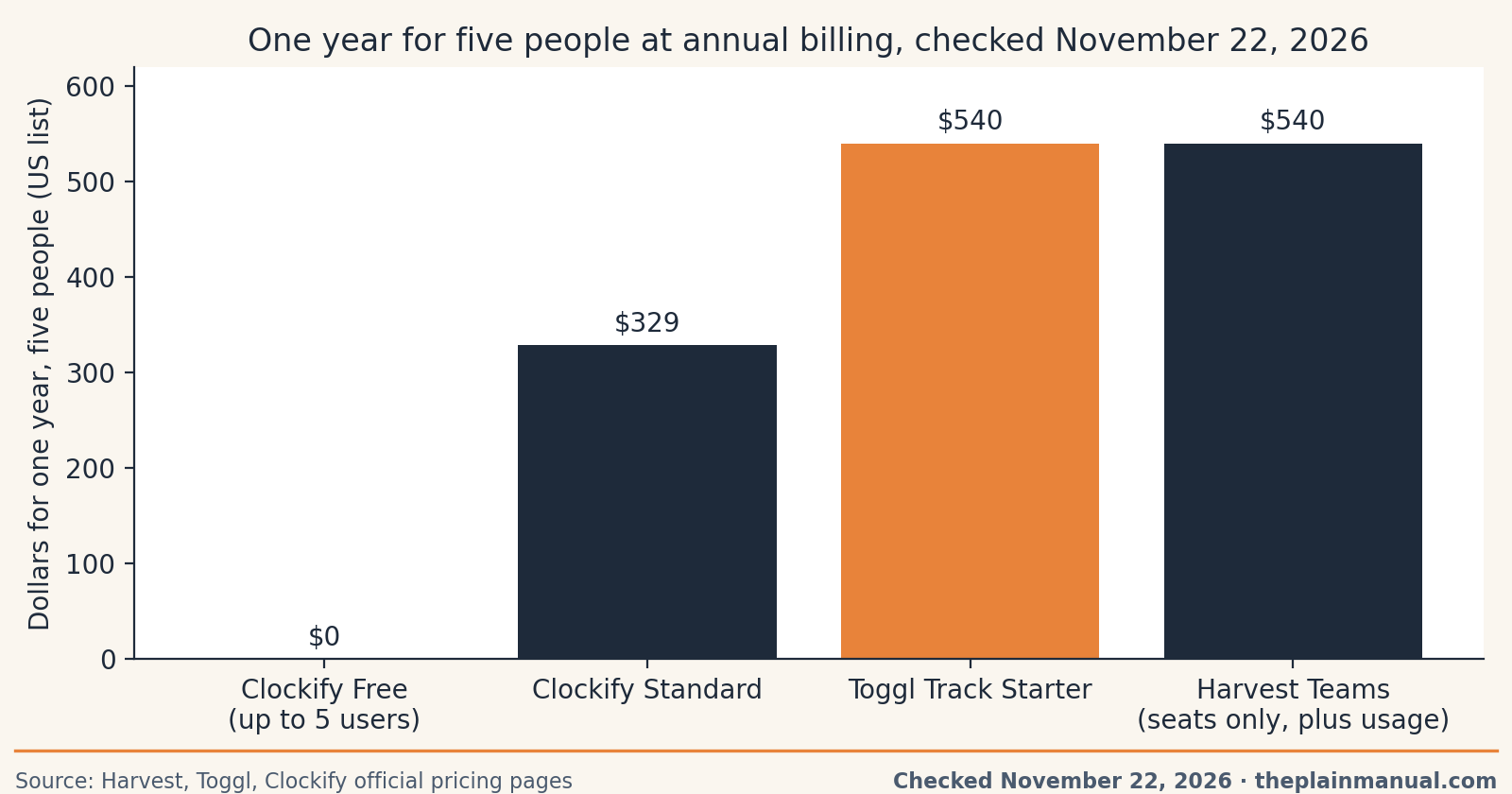
Read the table by predictability, not by price order. Clockify and Toggl print a total you can budget today. Harvest prints a floor. Kimai prints no price because there is no seller.
The price tag test: Toggl Track Starter costs $9 per user a month billed annually, $540 a year for five people, and that is the whole price.
Buy now or wait: FreshBooks' pricing page is running a Black Friday offer today, 90 percent off for 4 months, after which the list prices here apply, so price the renewal, not the teaser. For the other picks, no dated sale window appeared in this run's research.
Run your own numbers: payment fees and add-ons ride on top of several plans here. Our free Subscription Cost Calculator totals a year of any tool before you commit.
The migration checklist
- Export your time in detail: Reports, then Detailed, date range set to all time, download the CSV, while the account is fully active.
- Export invoices and expenses too, and save the PDFs of any invoice a client may question later.
- List every unpaid invoice on paper: number, amount, and currency, so the new tool starts from the same position.
- Reconcile before you cancel: total the exported hours and amounts per client and per currency against your last Harvest reports.
- Rebuild only the projects and clients still active. Archived history stays in the exports.
- Test one real client invoice in the new tool, including the payment link, before the whole team moves.
- Run both tools for one billing cycle if your renewal date allows, then cancel Harvest after the final old-system invoice is paid.
FAQ
Why did my Harvest bill jump if I did nothing?
Because the pricing model changed underneath your existing account, and for annual customers the new total first appears at renewal. BBC-reported cases rose as much as about 1,500 percent, steepest on older legacy plans.
What is the cheapest real alternative to Harvest?
Clockify Free, at $0 for up to five users. If you also need invoicing in the same tool, Clockify Standard at $5.49 per seat a month billed annually is the cheapest invoicing tier here, and FreshBooks Lite at $23 a month is the cheapest route that adds accounting.
Does Toggl Track send invoices like Harvest does?
No. The invoice itself is sent from an accounting tool. That split suits teams whose invoices already live in their accounting software.
Can I take my Harvest data with me?
Yes, in pieces. Harvest exports detailed time reports as CSV files across all time, plus invoices and expenses. There is no single move-everything button, so the exports are your archive.
Is it ever right to stay on Harvest?
Yes. If your usage figure, under Settings, then Billing, keeps your total close to the seat price, and the Unlimited quote is a number you can budget, staying avoids a migration entirely. Leave when the bill is unpredictable, not merely when the headline price moved.
First 30 days with your pick
Week 1 setup: export everything on the checklist first, then set up only active projects, clients, and rates in the new tool. Run one real client invoice through it before the team switches its timers.
Weeks 2 to 4, watch out for: timers still running in Harvest out of habit, billable rates that did not carry across, and invoice numbers that restart at 1 unless you set the starting number yourself.
Day-30 keep or cancel check: every trial here runs about 30 days, so decide before it converts. Can you state next year's cost in one sentence, from the pricing page alone? A yes means the move bought predictability. A no means you traded one meter for another.
Was this post useful? Answered it / Out of date / Still confused
Method: Research review (no hands-on testing). Prices and plan limits checked November 22, 2026 on the makers' official pricing pages and the BBC's August 2026 reporting.
Corrections: Spotted an error? Tell us, and we fix mistakes publicly.
Prices: US list prices; verify before buying.
Source: Harvest's pricing page, Clockify's pricing page, Toggl's pricing page, FreshBooks' pricing page, and the BBC, August 20, 2026.
Related Posts
 Alternatives to HoneyBook: After the Loyalty Discount Expired
- HoneyBook vs. Indy: Which Invoicing Tool Should a Freelancer Use? (2026)
- Alternatives to YNAB: The Method Is Fine, the $109 and the Homework Are Not
- QuickBooks Online vs Xero: Which Is Better After the 2026 Price Hikes?
- Asana vs Monday.com for a Small Team: Which One Is Worth Paying For? (2026)