

*Editor's Note: New post, November 2026. Prices and plan limits checked November 24, 2026, at regular list prices, and renewal prices are the ones used in the text.*
*Research review: prices and plan limits verified November 24, 2026 against YNAB's pricing page, Goodbudget's pricing, Actual Budget's own site, Monarch's official pricing page, and Copilot Money's official site. No hands-on walkthroughs, and no budget was migrated by us.*
In a sentence: YNAB's method still works, and every pick below keeps the useful part of it for less money, less weekly homework, or a wider view of your money, starting with Goodbudget Premium at $80 a year and Actual Budget at $0.
Plain-English Verdict
Keep the method, change the tool. If you love assigning every dollar and want the same discipline for less, Goodbudget Premium costs $80 a year and its free plan costs nothing. If you want that same envelope habit with no subscription at all, Actual Budget is free and open source, and your data stays on your own devices. If the homework itself is the problem, Monarch Core at $99.99 a year and Copilot Money at $109 a year trade strict assignment for an automatic household dashboard that includes net worth and investments.
The worry: you pay $109, fall two weeks behind on assigning and reconciling, and then face a catch-up session so uninviting that you stop opening the app while the subscription keeps renewing. Readers leaving YNAB describe that skipped-week homework pile in exactly those terms, and a budgeting app you no longer open is the most expensive kind there is.
How we checked this
Checked: YNAB's pricing page ($14.99 a month or $109 a year, 34-day free trial, no free plan after the trial); Goodbudget's pricing (Free with 20 envelopes, Premium $10 a month or $80 a year); Actual Budget's own site (free, open source, envelope budgeting, local-first); Monarch's official pricing page (Core $99.99 a year, Plus $199.99 a year, read first-hand today); Copilot Money's official site (annual offer $109, monthly offer $18, read first-hand today).
Date: November 24, 2026.
Method: Research review. See How We Review. We earn nothing if you buy any plan, and there are no affiliate links in this post.
YNAB is a budgeting app built on one rule: give every dollar you already have a job before you spend it, then move money between categories when real life disagrees.
Jargon Decoder: "Zero-based budgeting" just means: a plan where income minus planned spending equals zero, because every dollar got assigned somewhere on purpose, including savings.
The 60-second decision tree
- You love the method and want it cheaper: Goodbudget, free first, Premium if you outgrow it.
- You love the method and want no subscription: Actual Budget.
- You hate the weekly homework and want the whole picture: Monarch Core.
- You live on Apple devices and want the calmest dashboard: Copilot Money.
Skip this if…
Goodbudget — you need automatic bank imports on the free plan
Actual Budget — you will never set up your own sync server
Monarch Core — you need strict assign-every-dollar budgeting
Copilot Money — anyone in the household uses Android
YNAB itself — you want a free plan after the trial ends
Why people leave: the diagnosis
Three documented reasons show up again and again, and each points to a different pick.
The price: YNAB's subscription ladder climbed from $5 a month in its early subscription years to $11.99, then to today's $14.99 a month, or $109 a year. There is no free plan waiting at the bottom. When the 34-day trial ends, you pay the full price or you leave, and $109 a year makes YNAB one of the most expensive budgeting apps a household can choose.
The homework: the method asks for regular attention: assign income when it arrives, approve transactions, and reconcile accounts against the bank. Fans call that awareness. Plenty of former users call it a second part-time job, because skipping a week does not forgive the work, and the catch-up session grows less inviting every day it sits there.
The narrow view: YNAB is a budget, deliberately. It does a limited job of showing net worth and investments beside the monthly plan, so households wanting one dashboard for spending, debts, and investments keep a second tool anyway.
None of these reasons says the method failed. The method is the part worth keeping, which is why the picks below are grouped by which reason they solve.
Quick poll: What is pushing you away from YNAB: the $109 price, the weekly homework, or the missing big picture?
Same method, less money: Goodbudget
What it does in one sentence: Goodbudget turns the old cash-envelope system into an app, where you fill virtual envelopes first and spend from them second.
What we like: this is the closest method match to YNAB at a lower bill. The free plan is a real plan, not a trial: 20 envelopes (10 regular plus 10 for annual bills and goals), 1 account, 2 devices, and a year of history, entered by hand. Premium costs $10 a month or $80 a year, lifts the limits to unlimited envelopes and accounts, 5 devices, and 7 years of history, and adds automatic bank sync for US banks. That saves $29 a year against YNAB.
The price: free at $0 for as long as the free limits fit, then $80 a year for Premium. There is no per-person charge, and the free plan gives a couple two devices to share the same envelopes.
What could be better: The catch: the free plan is manual. Entering every purchase by hand is the price of $0. Bank sync lives behind Premium, and the free envelope count will pinch a detailed budgeter.
Our take: Who it's for: envelope loyalists who want the discipline, a genuine free starting point, and a paid tier that still undercuts YNAB.
Same method, no subscription: Actual Budget
What it does in one sentence: Actual Budget is a free, open-source envelope budgeting app that runs on your own devices and syncs through a server you control.
What we like: the price is $0, and that is the whole licence price. Actual's own site describes envelope budgeting based on money you actually have, the same core habit as YNAB, in a fast, local-first app. Your data lives on your devices, sync runs through your own server, and optional end-to-end encryption is available. Reports include net worth and cash flow. Because the software is open source under the MIT licence, no company can retire it or raise its price.
The price: the software costs nothing. Optional extras belong to other companies: one-click hosting on PikaPods runs about $1.50 a month per Actual's documentation, and US bank sync through SimpleFIN Bridge costs $15 a year. A fully synced Actual setup can therefore cost about $15 to $33 a year, against YNAB's $109.
What could be better: The fine print: you are the IT department. Sync needs that server, self-hosted or rented, and setting it up is a real task for a non-technical reader. There is no paid support desk, and phone use runs through the installable web app.
Our take: Actual suits a reader who likes the envelope method and will trade one setup afternoon for $0 renewals.
Less homework, wider view: Monarch
What it does in one sentence: Monarch is a household money dashboard that connects your accounts, tracks spending and cash flow, and shows net worth and investments beside the budget.
What we like: Monarch answers the two complaints the picks above do not. The homework shrinks because accounts sync on their own, and the view widens because investments, debts, and net worth sit beside the monthly budget. Core costs $99.99 a year or $14.99 a month, after a 7-day free trial, and a household member can join the same plan. Monarch's pricing page states plainly that it never sells financial data and shows no ads.
The price: Core at $99.99 a year saves only $9.01 against YNAB, so this pick is about the job, not the discount. Plus, at $199.99 a year, adds forecasting and deeper investment tools. Most households should price Core and skip Plus.
What could be better: The catch: the budgeting itself is looser. Monarch budgets by category or group, and that freedom is what some YNAB users are paying to escape. If assigning every dollar first is the habit that finally worked for you, a dashboard can feel like a step backwards. The 7-day trial is also the shortest on this page, and it asks for a payment method up front.
Our take: Monarch fits a household that wants one automatic view of everything and has made peace with guiding spending rather than assigning it.
Less homework, Apple edition: Copilot Money
What it does in one sentence: Copilot Money is a spending, budgeting, and investment tracker built for iPhone, iPad, and Mac, with a web app added in December 2025.
What we like: accounts connect, transactions categorize automatically, and budgets, investments, and net worth share one calm screen. For an Apple household that found YNAB's upkeep heavy, Copilot is the low-friction version.
The price: read this carefully, because it changed. Copilot's official site now lists $109 a year and $18 a month. Older guides, including our own October 2026 coverage, quoted $95 a year and $13 a month. At $109, Copilot no longer undercuts YNAB. It earns its place on design and automation, not price.
What could be better: there is no Android app, so a mixed-device household cannot share it. There is no free plan, only a trial, and availability is US-only. The price rise is itself a warning: a budgeting app can reprice just like YNAB did.
Our take: Copilot suits an Apple-only household that values calm design over the strict assign-first method.
The prices, side by side
| Plan | Per year | What the year buys |
|---|---|---|
| Actual Budget (self-hosted) | $0 | Envelope budgeting, your data on your devices |
| Goodbudget Free | $0 | 20 envelopes, 1 account, 2 devices, manual entry |
| Goodbudget Premium | $80 | Unlimited envelopes and accounts, US bank sync |
| Monarch Core | $99.99 | Dashboard, sync, net worth, household sharing |
| Copilot Money (annual) | $109 | Automatic tracking for Apple and web, no Android |
| YNAB (annual) | $109 | Strict zero-based budgeting, 34-day trial, no free plan |
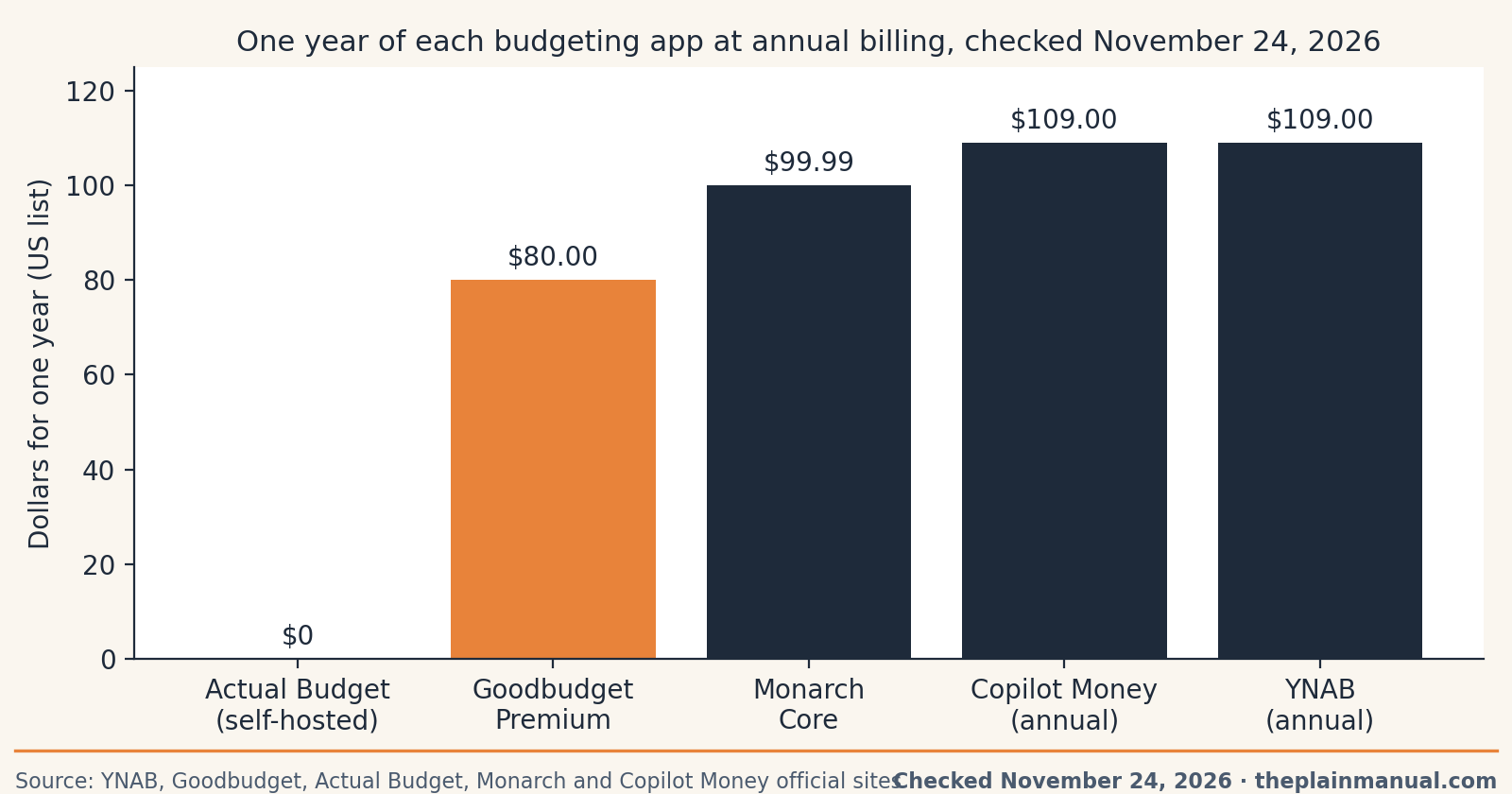
Read the table by reason. The two $0 rows keep the method and change who does the work: you enter transactions by hand in Goodbudget Free, and you run the sync server in Actual. The two $109 rows buy opposite things: discipline from YNAB, automation and design from Copilot.
The price tag test: Goodbudget Premium costs $80 a year for unlimited envelopes, unlimited accounts, and bank sync, and that is the whole price.
Buy now or wait: no dated sale window for any pick appeared in this run's research, and Actual is free at every date, so waiting gains nothing we could document. The timing fact that matters is your YNAB renewal date: run the new app beside it for the overlap weeks below, and cancel before the next $109 charge.
What staying costs, honestly
Fairness asks for the other side. YNAB's 34-day trial is the longest on this page, and a household that keeps up with the weekly routine may get $109 of value from the habit alone. If your budget is current and you open the app without dread, the cheapest alternative is the one you already have. Leave when the price, the homework, or the narrow view is the thing actually failing you.
The migration checklist
- Export first: download your YNAB history and reports before you cancel, and keep the file somewhere you control.
- Finish the current month in YNAB, so the new app starts on a clean month boundary instead of mid-stream.
- List your categories and balances on paper, then rebuild only the categories you actually used in the last three months.
- Connect or import accounts in the new app, and check its starting balances against the bank, not against memory.
- Run both apps in parallel for two to four weeks, approving transactions in the new one and only glancing at the old one.
- Cancel YNAB before the renewal date once the new app has survived a full month, and save the cancellation confirmation.
FAQ
Is there a free alternative to YNAB that keeps the same method?
Yes, two. Goodbudget Free keeps envelope budgeting at $0 with 20 envelopes and manual entry, and Actual Budget keeps envelope budgeting at $0 with no subscription at all, in exchange for running your own sync setup.
How much does YNAB cost in 2026?
$14.99 a month, or $109 a year, after a 34-day free trial. There is no free plan after the trial, and the annual price works out to about $9.08 a month.
Which alternative is closest to YNAB?
Goodbudget, on method. Both tools make you decide where money goes before you spend it. Goodbudget uses envelopes where YNAB uses categories, its free plan is manual, and its Premium plan at $80 a year adds bank sync for US banks.
Did Copilot Money raise its price?
Yes. Copilot's official site now lists $109 a year and $18 a month. Coverage from October 2026, including ours, listed $95 a year and $13 a month. Check the price on Copilot's own site before you subscribe, because app store prices can differ by country.
First 30 days with your pick
Week 1 setup: export your YNAB data, start the new app at the beginning of a month, rebuild only the categories you used in the last three months, and set starting balances from the bank's own figures.
Weeks 2 to 4, watch out for: the overlap temptation. Checking two apps daily doubles the homework you were escaping. Open the new app for daily work, and open YNAB only to compare totals on Sundays.
Day-30 keep or cancel check: compare this date with your YNAB renewal date. If the new app is current and your totals match the bank, cancel YNAB and keep the saving. If the new app is already two weeks stale, the tool was not the problem.
Was this post useful? Answered it / Out of date / Still confused
Method: Research review (no hands-on testing). Prices, plan limits, and trial terms checked November 24, 2026 on the makers' official pricing pages and sites.
Corrections: Spotted an error? Tell us, and we fix mistakes publicly and date them.
Prices: US list prices; verify before buying.
Source: YNAB's pricing page, Monarch's pricing page, Actual Budget's site, and Copilot Money's official site, as read November 24, 2026.
Related Posts
 Bitwarden vs LastPass: Switching After the Breaches, in Plain English (2026)
- 1Password vs Apple Passwords: Should You Just Use the Free One? (2026)
- Alternatives to HoneyBook: After the Loyalty Discount Expired
- HoneyBook vs. Indy: Which Invoicing Tool Should a Freelancer Use? (2026)
- Dropbox vs Google Drive: Which Should Hold Your Files? (2026)