*Editor's Note: New post, November 2026. Prices and fees checked November 7, 2026, at regular list prices on annual billing unless a monthly price is stated.*
*Research review: pricing and fees verified November 7, 2026 against Shopify's official pricing page and Etsy's Fees and Payments Policy. We did not open a new shop on either platform for this piece.*
In a sentence: start on Etsy if strangers need to find your product, because its search is the one thing its fees buy, and move to Shopify once buyers already come from you and the monthly rent beats the per-sale cut.
Plain-English Verdict
Etsy is the safer start for most digital sellers. There is no monthly bill, a listing costs 20 cents, and people already search Etsy for planners, templates, and downloads. Shopify keeps more of each sale, $9.41 of a $10 sale before its subscription, and gives you your own store and customer list. It also brings you no buyers at all, so it pays only once your own traffic is real.
The worry: you look at a small payout and wonder where the rest of a $10 sale went, or you pay a monthly store rent for months while nobody visits. Seller coverage in 2026 returns to that payout moment on Etsy, a stack of small fees on a small price, and to the quiet version on a private store, a bill that arrives whether a sale does or not.
How we checked this
Checked: Shopify's official pricing page, read November 7, 2026 (Basic, Grow, and Advanced prices, card rates, third-party fees, included marketing tools); Etsy's Fees and Payments Policy, read the same day (listing, transaction, Offsite Ads, and set-up fees, plus the $10,000 threshold); Shopify's Help Center Starter plan page, as read in November 2026 coverage.
Date: November 7, 2026.
Method: Research review. See How We Review. We earn nothing if you buy any plan, and there are no affiliate links in this post.
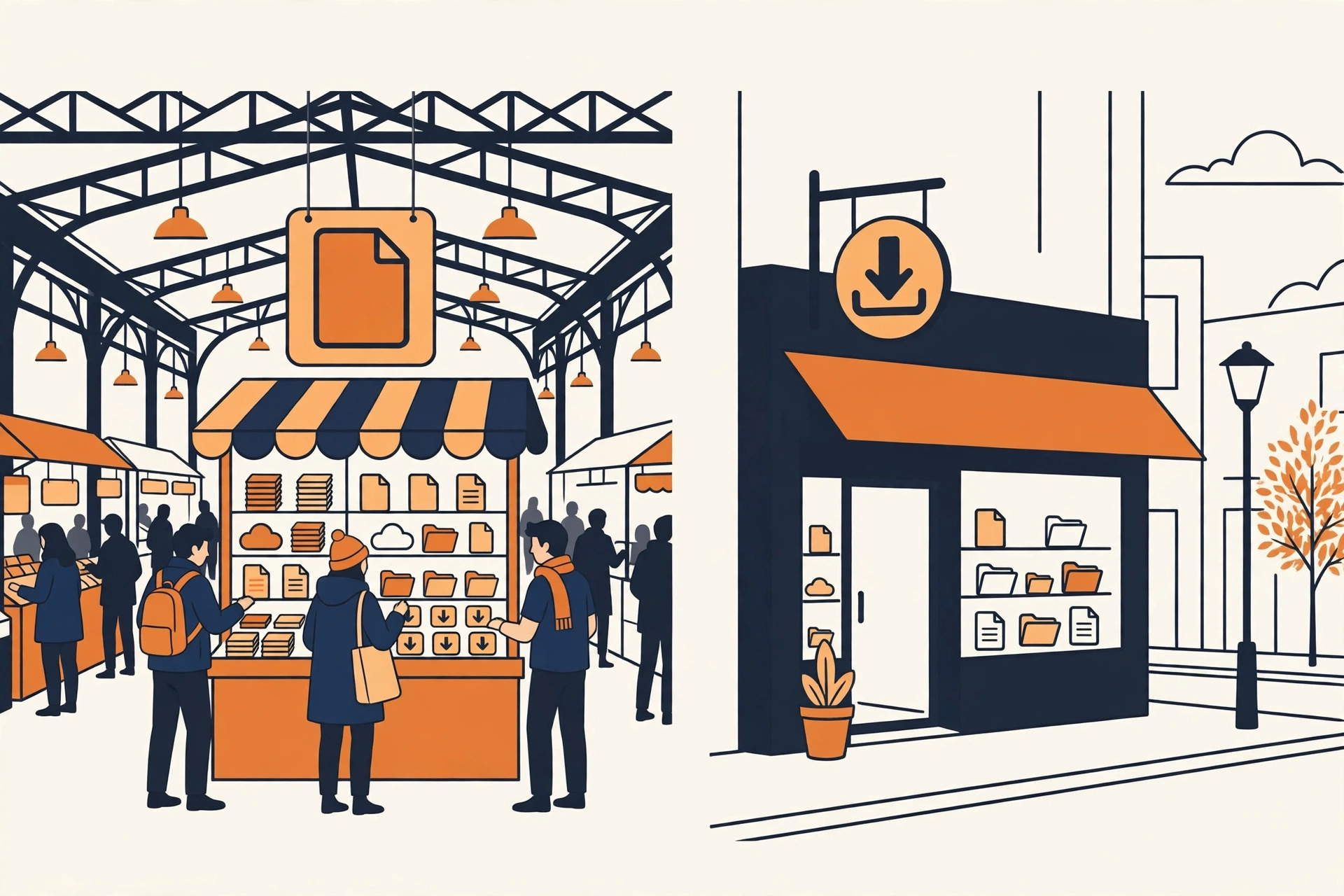
Here is what each one does in one sentence. Etsy is a shopping centre where you rent a small stall and the centre brings the shoppers. Shopify is a shop you build on your own street, with a better till and no shoppers unless you invite them.
Jargon Decoder: "Merchant of record" talk aside, the plain split is this: a marketplace sells inside someone else's audience, and a storefront sells inside your own.
The 60-second decision tree
- You have no audience and one product to test: start on Etsy.
- People already find you through search, social posts, or an email list: price Shopify seriously.
- You sell about 36 or more $10 downloads a month: Shopify Basic starts to win on fees alone.
- Your price is $5 or less: Etsy's fixed fees bite hard, so volume and traffic matter even more.
- You want your own domain, discounts, and customer emails: that is Shopify's home ground.
- You want the file delivered with no extra app or setup: Etsy's instant downloads do that inside the listing.
Our picks, by role
Etsy: our pick for your first digital product
Etsy is the pick when the product needs to be discovered. A buyer can search for a wedding checklist or a budget planner and land on a shop that opened last week. Downloads are delivered by Etsy after payment, reviews collect on the listing, and the whole test costs 20 cents a listing plus fees only when something sells.
Shopify: our pick when the buyers are already yours
Shopify is the pick when traffic arrives from your own work: a blog, a channel, a list, a community. Basic gives you a full store on your own domain, unlimited products, discount codes, email campaigns, and abandoned checkout recovery, all listed on its pricing page. The per-sale cost is the lowest in this comparison, and the customer relationship is yours.
Skip this if…
Etsy — you already have steady traffic of your own
Etsy — a 15 percent ad fee on some sales ruins your price
Shopify — you need strangers to discover the product
Shopify — a $29 monthly bill before your first sale feels heavy
TPM Scorecard
Scores grade published facts only: pricing pages, fee policies, and help docs. We do not score how a platform feels to use.
| Criterion | Shopify | Etsy |
|---|---|---|
| What it costs | 6 | 7 |
| Does the job | 8 | 7 |
| Works where you work | 9 | 6 |
| Help when stuck | 8 | 7 |
| Free version | 2 | 4 |
| Overall | 6.6 | 6.2 |
The gap is 0.4, so this one is too close to call on the facts. Shopify scores ahead on the store it gives you. Etsy scores ahead on starting cost, and its real advantage, a marketplace full of buyers, is a traffic fact a feature table can only partly hold. The sections below put prices on both, and your traffic source settles the tie.
TPM Scorecard · Rubric v1.0 — October 2026 · Checked November 7, 2026. See How We Review.
Use our numbers: Cite this post: "Shopify vs Etsy for Selling Digital Products: Which Should You Use? (2026)" — The Plain Manual, November 7, 2026. https://theplainmanual.com/shopify-vs-etsy-digital-products/ Download the scorecard as a CSV: https://theplainmanual.com/wp-content/uploads/2026/11/shopify-vs-etsy-scorecard.csv
The picks, one by one
Shopify
What we like: The sale itself is cheap. On Basic, a standard online card payment costs 2.9 percent plus 30 cents, so a $10 download loses 59 cents and keeps $9.41 before the subscription. The store around that sale is complete: unlimited products, your own domain, discount codes, gift cards, email campaigns to unlimited contacts, customer segments, and abandoned checkout recovery. If you later sell physical products too, the same store handles both.
What could be better: The catch: two costs hide behind the tidy plan price. First, the rent: Basic is $39 a month paid monthly, or $29 a month billed yearly, $348 a year before the first sale. Second, digital delivery needs an app. Downloads are not the store's native job, so you add a download app, and while Shopify's own download app is free, the polished third-party ones charge monthly fees that belong in your real total. Use a payment provider other than Shopify Payments and a third-party fee applies too, 2 percent on Basic, on top of that provider's own charges.
Pricing: Basic $39 a month monthly billing or $29 a month billed yearly. Grow $105 or $79, with a 2.7 percent plus 30 cents card rate. Advanced $399 or $299, at 2.5 percent plus 30 cents. A short free trial exists, and the $5 Starter plan older guides recommend is closed to new stores, covered in today's companion note.
Our take: Who it's for: sellers with an audience, a growing catalogue, or a brand they want to own outright. Price it as rent plus 59 cents a $10 sale, never as 59 cents alone.
Etsy
What we like: Starting costs almost nothing and the shop can be found on day one. A listing is 20 cents for four months, there is no monthly plan you must buy, and Etsy's own search puts downloads in front of buyers who arrived ready to buy one. Delivery is built in: a digital item reaches the buyer as an instant download, with no app to choose. Reviews sit on the listing and do the persuading for the next buyer.
What could be better: The price: the fee stack is several small charges that add up on a small price. On a $10 sale a US seller pays 20 cents of listing fee, 65 cents of transaction fee at 6.5 percent, and 55 cents of payment processing at 3 percent plus 25 cents, $1.40 in all. Then comes the layer sellers argue about. If a buyer clicked an Etsy ad on another site and ordered within 30 days, Offsite Ads takes another 15 percent, $1.50 on that same sale. Shops under $10,000 in sales over the prior year can opt out. Past $10,000 the fee drops to 12 percent and taking part is mandatory for the life of the shop. A new shop may also be charged a one-time set-up fee, shown during onboarding.
Pricing: No required subscription. Listing $0.20 each, transaction 6.5 percent, US payment processing 3 percent plus $0.25 a order, Offsite Ads 15 percent or 12 percent only on attributed orders, capped at $100 a order. Etsy Plus, at $10 a month, is an optional bundle of credits and tools, not a requirement.
Our take: Pick Etsy when discovery is the problem you are paying to solve. Read every payout with the Offsite Ads line in mind, and opt out while you are under the threshold if the math says so.
Pricing side by side
| Cost | Shopify Basic | Etsy |
|---|---|---|
| Fixed cost | $29/mo billed yearly ($39 monthly) | $0.20 per listing, 4 months |
| Fee on a $10 sale | $0.59 card fee | $1.40 in standard fees |
| You keep from $10 | $9.41 before subscription | $8.60 |
| If an outside ad brought the sale | No extra platform fee | $7.10 after the 15 percent ad fee |
| One-time start cost | None beyond the plan | A set-up fee may apply at onboarding |
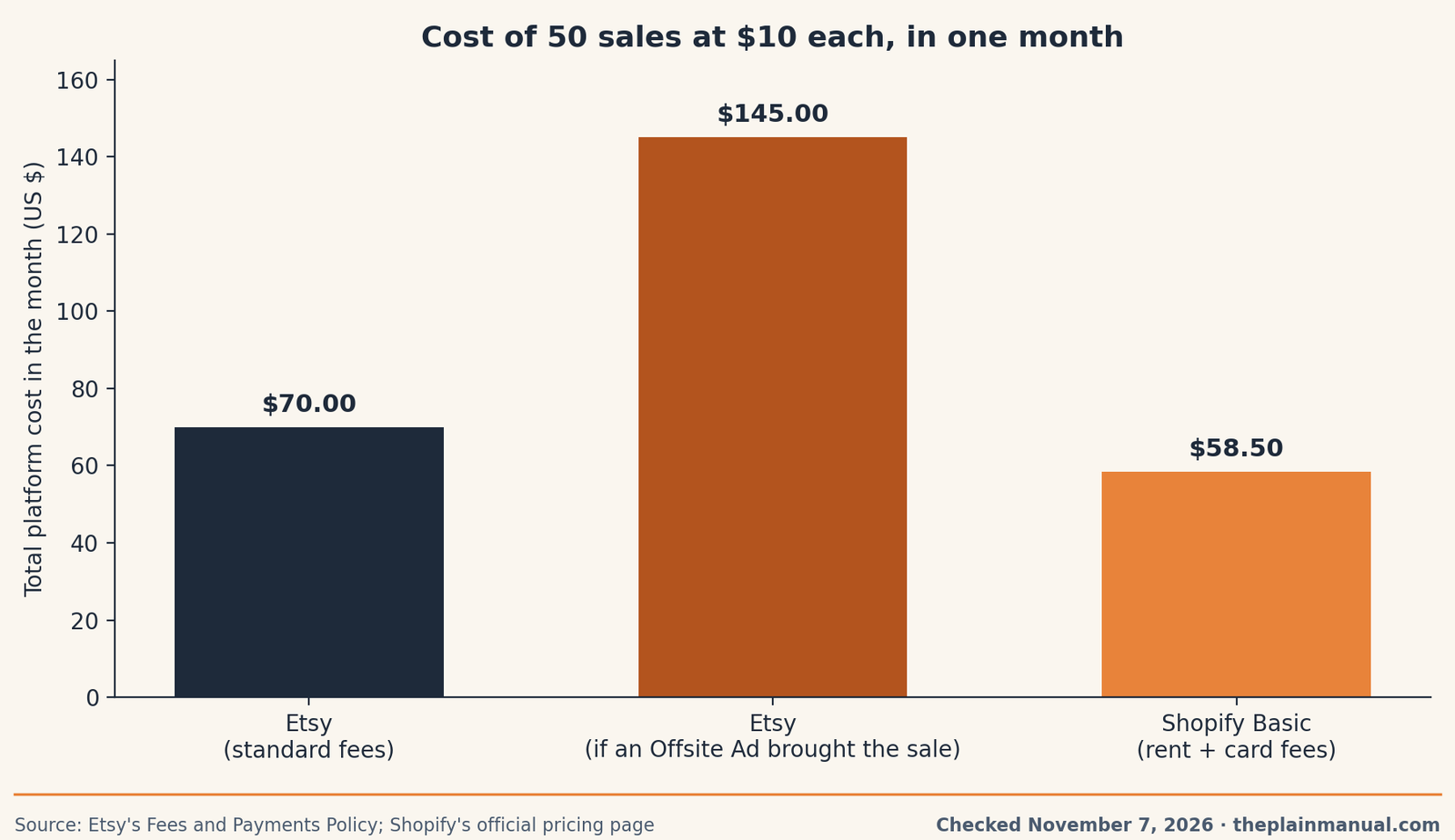
The price tag test: Shopify Basic keeps $9.41 of a $10 sale, and the blocker is the rent, $29 a month billed yearly due before and between sales, so the full price is the subscription plus 59 cents a sale.
Buy now or wait: neither platform published a sale window for these plans in this run's research. Etsy's fees do not discount, and Shopify's standing saving is yearly billing, $29 against $39 a month on Basic, so waiting gains nothing we can verify.
The fine print: the Etsy example counts one listing fee against one sale, which matches a listing that sells and renews. A listing that never sells still costs its 20 cents, and a listing that sells many copies spreads that first fee wider. Shopify figures use Shopify Payments; another provider adds the third-party fee named above.
The break-even month, in plain numbers
The fixed rent is why volume settles this. At $10 a sale, Shopify saves 81 cents a sale against Etsy's standard fees, $1.40 against $0.59. Divide the $29 monthly rent by 81 cents and Shopify pulls ahead at about 36 sales a month. Below that, Etsy is cheaper even though it keeps less of each sale. At 10 sales a month, Etsy takes $14.00 in fees while Shopify takes $34.90 in rent and card fees. At 50 sales, Etsy takes $70.00 and Shopify takes $58.50. At 100 sales, the gap widens: $140.00 against $88.00.
Price changes the count. On a $25 download, Etsy takes $2.83 and Shopify takes $1.03, a saving of $1.80 a sale, so about 17 sales a month cover the rent. On a $5 download, Etsy takes $0.93 and Shopify takes $0.45, and the fixed 25 and 30 cent pieces explain why cheap products feel fees so sharply on both platforms. Our free Subscription Cost Calculator shows what a $29 monthly rent becomes over five years, which is the honest frame for the Shopify side of this choice.
The traffic question decides the rest
Who it's for: this section is for the seller tempted to move purely to save fees. A fee saving only counts on sales that still happen. Etsy's 6.5 percent transaction fee buys a place in a search box buyers already use, and that is why so many first products start there. Shopify's pricing page lists selling on social channels, marketplaces, and AI chats among Basic's features, and those are pipes you fill yourself: your posts, your videos, your email list, your search rankings. Our guide to the best website builder for a side hustle covers the store-building side, and our Mailchimp vs Kit comparison covers the email list that makes a private store work.
One rule protects you if you run both, a setup many sellers land on. Etsy bars steering a buyer who found you on Etsy into buying elsewhere to dodge fees. So let each channel do its own job: Etsy for the buyers Etsy finds, your store for the buyers you find. Moving a proven product to Shopify for your own traffic is a normal second step. Moving on day one, with no traffic, trades a fee problem for a silence problem.
FAQ
Which platform is cheaper for my first sale?
Etsy, by a wide margin. Your first $10 sale costs $1.40 in standard fees there. On Shopify the same sale costs 59 cents in card fees plus a month of rent, $29 on yearly billing, before it happens.
Can I sell the same digital products on both platforms?
Yes. Nothing in either platform's documented terms requires exclusivity for a normal digital catalogue. Keep prices and files in step, and respect Etsy's rule against steering its buyers off the platform to complete a sale elsewhere.
Does Shopify deliver downloads by itself?
Not as a built-in store feature. You add a download app, Shopify's own is free, and delivery runs through it after checkout. On Etsy, instant download delivery is part of the listing itself.
Can I turn off Etsy's Offsite Ads?
Yes while your shop stays under $10,000 in sales over the prior 365 days. Once a shop reaches that line, the fee becomes 12 percent and participation is required for the life of the shop, per Etsy's fee policy.
When should a seller move from Etsy to Shopify?
When your own channels send you buyers every week, or when the break-even math above turns in Shopify's favour, about 36 sales a month at $10 or about 17 at $25. Many sellers keep the Etsy shop open for discovery after opening their own store.
Method: Research review (no hands-on testing). Cross-checked against Shopify's official pricing page and Etsy's Fees and Payments Policy, both read November 7, 2026, plus November 2026 coverage of Shopify's Help Center Starter plan page. Checked November 7, 2026.
Corrections: Spotted an error? Tell us, and we fix mistakes publicly and date them.
Prices: US list prices; verify before buying.
Source: Shopify's official pricing page and Etsy's Fees and Payments Policy
Related Posts
 Squarespace vs Wix: Which Is Better for a Small Business? (2026)
- Alternatives to Squarespace: After the July 2026 Price Increase
- WordPress vs Squarespace: Which One Owns Your Website? (2026)
- TickTick vs Microsoft To Do: Which Free To-Do App Should You Use? (2026)
- HoneyBook vs. Indy: Which Invoicing Tool Should a Freelancer Use? (2026)