

Editor’s Note: First published October 2026.
Evidence: Research review — the uses and prices below come from the vendors’ official pricing pages and help docs (plus clearly-flagged third-party reporting where we couldn’t read the official page), current as of October 2026. We didn’t trial each tool hands-on, so this is a researched guide, not a testing lab. No affiliate links here; we earn nothing if you buy.
Plain-English Verdict: AI’s real value for a small business is five boring jobs: meeting notes, writing help, website chat, design, and receipts — doable for roughly $50–85/month total, some of it free. Skip the hype: no AI will “run your business on autopilot,” and anyone selling you that is selling you the dream, not the tool.
What we actually did
We priced five concrete AI uses from official sources, meeting notes, writing, customer chat, design, and expense tracking, and noted exactly where each price came from, including where we had to rely on reputable third-party reporting because the vendor’s own page wouldn’t render. Every price below is in USD per month as of October 2026; check the official pages before buying, because AI pricing changes constantly. This site has no affiliate links, so our only incentive is being right.
The honest version of the pitch
What the marketing says: “AI will 10x your business.” What it actually is: a handful of genuinely useful assistants for tedious jobs, each costing less than a nice lunch per month. Surveys suggest somewhere between 60 and 75% of small businesses now use some AI (the OECD’s 2026 SME survey found 61%; a Homebase survey of US small businesses found 74%), but the same surveys show most are just using simple off-the-shelf tools for isolated tasks. Translation: everyone’s experimenting, almost nobody has been transformed. That’s fine. Boring is profitable.
Five boring uses that actually work
1. Meeting notes that write themselves, ~$0–20/month
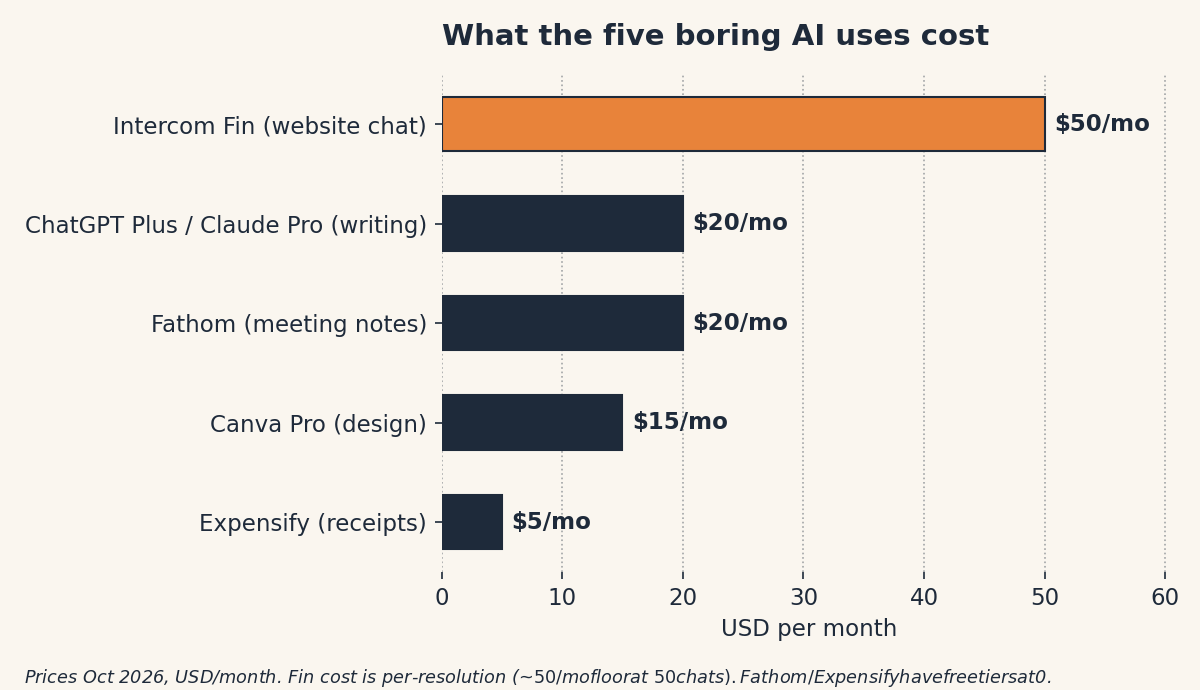
If you take client calls, an AI notetaker joins the meeting, transcribes it, and hands you a summary with action items. Fathom’s free tier covers individuals with unlimited recordings and transcriptions; its paid plan runs about $16–20/month (third-party reported, Fathom’s own pricing page didn’t render for us). Our Fathom vs. Otter.ai comparison goes deeper. The honest caveat: AI summaries occasionally invent an action item nobody assigned. Skim before you forward.
2. A writing helper for the words you dread, $20/month
Job postings, product descriptions, awkward client emails, website copy. ChatGPT Plus ($20/month) or Claude Pro ($20/month, or $17 billed annually), both official prices, draft all of it in seconds. This is the single highest-value AI spend for most small businesses, because writing is where owners burn hours. The honest caveat: it’s a first draft, not a final draft. Publish its output unedited and your business will sound like everyone else’s.
3. An AI receptionist for your website, from ~$50/month
Intercom’s Fin answers common customer questions on your site 24/7, hours, pricing, “where’s my order”, and hands tricky ones to you. It charges per resolved conversation, about $0.99 each, which works out to roughly $50/month for a business handling ~50 AI chats monthly (consistent across multiple 2026 pricing analyses; Intercom’s own calculator confirms the per-resolution model). The honest caveat: it only knows what you teach it. A chatbot trained on an outdated FAQ is worse than no chatbot.
4. Design help without hiring a designer, $15/month
Canva Pro (about $15/month, broadly corroborated across current reviews, we couldn’t render Canva’s own pricing page) bundles its Magic Studio AI tools: background removal, image generation, instant resizing of one design into every social format. For menus, flyers, social posts, and simple ads, it replaces the $50-a-pop freelancer for routine work. The honest caveat: it makes competent design, not distinctive design. Your brand still needs a human eye.
5. Receipts that file themselves, $0–5/month
Expensify’s free plan includes unlimited SmartScan receipt scans; its Collect plan is about $5 per user per month (reported by Quicken’s editorial team, Expensify’s own page didn’t render for us). Snap a photo of a receipt and the AI categorizes it and checks it against your expense policy. If you’ve ever done bookkeeping on a Sunday night from a shoebox, you understand the value proposition instantly. The honest caveat: AI categorization is a suggestion engine. Reconcile monthly like a grown-up.
The real monthly math
| The boring use | Tool | Cost/month |
|---|---|---|
| Meeting notes | Fathom | $0 free · ~$16–20 paid |
| Writing helper | ChatGPT Plus or Claude Pro | $20 |
| Website chat | Intercom Fin | ~$0.99 per resolved chat (~$50/mo floor) |
| Design | Canva Pro | ~$15 |
| Receipts & expenses | Expensify | $0 free · ~$5/user paid |
| Everything, all in | Roughly $50–85/month |
This cost card is our original synthesis from vendor pricing pages and flagged third-party reporting, October 2026, the artifact for this post.
Three hyped uses to skip (for now)
Jargon Decoder: An “AI agent” is just a chatbot that’s been given permission to do things, not just say things, click buttons, send emails, move money. The hype treats “agent” as “employee.” The honest version: it’s an intern with no judgment and no accountability, which is why every use below needs a human checking its work.
1. “AI employees” that run your business on autopilot
What the marketing says: “Hire an AI workforce.” The honest version: autonomous AI agents that handle customers, orders, and decisions without supervision are a demo, not a product. They make confident mistakes at machine speed. Until an AI can be accountable for a mistake, it can’t; you are, keep a human in every loop that touches money or customers.
2. AI-generated blog content at scale
What the marketing says: “Publish 100 SEO articles a month.” The honest version: search engines have spent two years learning to spot and bury mass-produced AI content, and readers can smell it instantly. One genuinely useful article beats a hundred generated ones, which, not coincidentally, is this entire website’s business model.
3. AI phone agents calling your customers
What the marketing says: “Never miss a lead, AI answers every call.” The honest version: robocall-style AI callers irritate customers, misroute the important calls, and in several US states now trigger disclosure laws requiring the caller to announce it’s AI. A missed call returned personally within the hour still beats an AI that answered immediately and annoyed everyone.
Curious what all those meetings cost? Our free Meeting Cost Calculator does the math in seconds, no signup.https://theplainmanual.com/tools/meeting-cost-calculator/
The plain verdict
AI for a small business isn’t a revolution, it’s five competent interns who cost $50–85 a month combined, never sleep, and occasionally need supervision. Start with the writing helper (the $20 that pays for itself fastest), add meeting notes if you live on calls, and ignore anyone selling you autopilot. The businesses winning with AI in 2026 aren’t the ones using the most of it. They’re the ones using the boring parts well.
FAQ
How much does AI cost for a small business?
The five most useful AI tools run roughly $50–85/month combined, and you can start with the free tiers at $0. The single best first spend is a $20/month writing assistant.
Will AI replace my employees?
No, and be wary of anyone selling you that. Today’s AI handles narrow, tedious tasks well but can’t be accountable for mistakes. It assists staff; it doesn’t replace them.
What’s the easiest AI win for a non-technical owner?
An AI writing helper (ChatGPT Plus or Claude Pro, $20/month). Everyone dreads some kind of writing, and it’s the fastest way to feel the value.
Is my business data safe with AI tools?
Mostly, with caveats: use business/paid tiers (which typically exclude your data from training), don’t paste passwords or sensitive customer data into prompts, and check each vendor’s data policy. Free consumer tiers are the ones most likely to train on your inputs.
Do I need to train my staff to use AI?
Barely. The tools above are designed for normal humans, if someone can use email, they can use these. The training that matters is judgment: always review AI output before it reaches a customer.
Sources
Built from official pricing pages and help docs, October 2026: OpenAI (ChatGPT Plus) and Anthropic (Claude pricing). For related small-business software coverage, see our best invoicing software for freelancers roundup. Third-party-reported figures (flagged in-text): Fathom pricing via Fireflies’ 2026 Fathom review; Intercom Fin per-resolution pricing via 2026 pricing analyses; Expensify pricing via Quicken editorial; SME adoption stats via the 2026 OECD D4SME survey and Homebase’s September 2026 report. We did not trial each tool hands-on. Pricing changes often, check official pages before buying. No affiliate links. Read our methodology.
Editor’s Note: First published October 2026.
Want one plain-English software take in your inbox every week? Subscribe to The Plain Manual newsletter, no spam, unsubscribe anytime.

4 thoughts on “What Can AI Actually Do for a Small Business? (2026)”